

Oregon’s first stand-alone graduate degree in renewable energy engineering
About the MSREE Program
The Master of Science in Renewable Energy Engineering (MSREE) program is offered fully online. The MSREE program has been structured to accommodate both full-time students and working professionals. The MSREE program is designed to prepare graduates to be energy engineering professionals who have advanced knowledge and skills that enable them to assume a broad range of technical leadership roles in nascent and established industries, government entities and non-governmental organizations (NGOs).
Specialized Sequences
The MSREE program at Oregon Tech allows students to select from a wide variety of specializations including Energy Storage, Advanced Energy Storage, Electrical Power Systems, Photovoltaic Systems, Electric Vehicles, among others.
Jobs and Careers in Renewable Energy Engineering
Per the 2024 U.S. Energy and Employment Report from the U.S. Department of Energy, jobs in clean energy grew at more than twice the rate of the overall U.S. labor market. The MS Renewable Energy Engineering curriculum prepares graduates for engineering careers in the energy sector in general, and the renewable/clean energy industry in particular. Graduates of the program will be prepared for immediate employment as design engineers, field engineers, plant engineers, utility engineers, energy auditors, renewable energy system integrators for homes and businesses, local and state government renewable-energy planners, and other positions in the energy field; or for further study in REE or other related fields.
Career Paths:
| Our graduates work for:
|
Contact
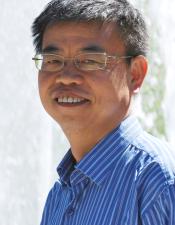
Dr. Feng Shi is currently an associate professor in Department of Electrical Engineering and Renewable Energy Engineering (EEREE) at Oregon Institute of Technology (OIT). His research interests lie in dramatically increasing efficiency, substantially decreasing cost, and radically smoothing intermittence of solar energy systems. He has been succeeding in researching and developing ultra-high efficiency photonic crystal solar spectrum splitter-based integrated circuitry concentrating photovoltaic systems, extremely low-cost non-tracking non-imaging inflatable solar concentrator-based concentrating solar systems, and super-long duration CO2-based solar fuel energy storage systems. His research interests are also extended to hybrid electric motor and hydrogen internal combustion engine vehicles with swappable battery modules and swappable hydrogen tanks. His research interests have also been extended to electromagnetics, photonic and electronic materials and devices, and electric power grid systems