

Students analyze environmental conditions and problems through applied research and fieldwork, all within the stunning natural setting of the Klamath Basin.
Natural Resources Master Programs
Preparing Students
A Master’s degree in Natural Resources prepares students for leadership roles in the management, conservation, and restoration of ecosystems, working landscapes, and natural resource systems. Graduates are equipped for employment with federal and state agencies, tribal governments, consulting firms, nongovernmental organizations, and for continued doctoral studies. The program emphasizes advanced field skills, analytical tools, and applied research to address complex natural resource challenges across ecological, social, and policy dimensions.
Students develop expertise in evaluating ecosystem conditions, designing monitoring programs, conducting resource assessments, and implementing science-based management and restoration strategies. Coursework integrates ecological understanding with quantitative analysis, communication, and decision-making frameworks needed for professional practice.
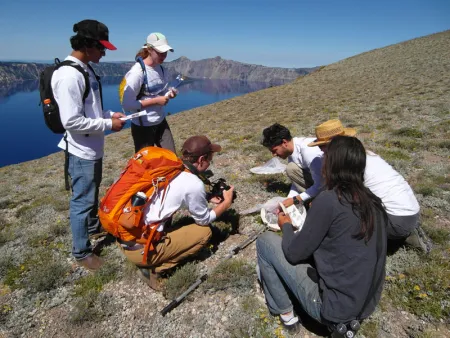
The curriculum builds on four interconnected cores:
- Data analysis: advanced statistics, quantitative ecology, R modeling, geospatial analysis, and geographic information systems (GIS) to support resource assessment, habitat modeling, and landscape-scale management.
- Natural sciences: graduate-level coursework in ecology, wildlife biology, fisheries, hydrology, soils, botany, climate science, and biophysical processes that shape natural systems.
- Technical electives: specialized training in wildlife and plant ecology, forest and rangeland management, watershed management, restoration ecology, conservation planning, environmental monitoring, and natural resource policy.
- Integrated social sciences: economics, human dimensions of natural resources, environmental planning, resource governance, and regional studies that link ecological systems with social, cultural, and economic drivers.
Contact

My personal and professional lives have always been centered on Outdoor Experiences. As the director of the Environmental Sciences program at Oregon Tech, I get to combine my love of nature and technical skills to promote data driven decision making in natural resource management. I have experience teaching the following courses: ENV data analysis, careers and professionalism, physical geography, intro to general chemistry, general biology, nutrition, environmental education, human anatomy, backpacking, intro to GIS, water resources, stream water chemistry, riparian assessment, and pollinator ecology. My current research is centered on pollinators. I co-advise the Beekeeping club on campus, and we use our apiary as a living laboratory for undergraduate research. In addition to honeybees, our students are conducting native pollinator surveys. Data from these ongoing studies will be used to track shifting phenological trends in response to climate change and increased forest fire activity within the Klamath Basin. When not on campus, you may find me with my family on the trail, riding my road bike, walking my two French bulldogs, playing ukulele, or paddling on the scenic waterways of southern Oregon.