
To help meet critical workforce needs in the domestic energy sector while driving economic growth, job creation, and strengthening national energy security, a bill was recently passed for Energy and Water Appropriations. Included in the bill was $1.123 million to advance Oregon Tech’s work in next-generation energy technologies.
The project was championed by Senators Ron Wyden and Jeff Merkley, who helped Oregon secure more than $100 million in federal funding for critical community projects across the state.
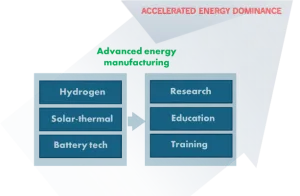
This funding for Oregon Tech will be used at the Klamath Falls and Portland-Metro campuses to develop applied research, education, and training in hydrogen production, solar and solar-thermal systems, emerging battery technologies, and long-duration energy storage.

Naga Korivi, Ph.D., Chair of the Electrical Engineering and Renewable Energy Department at Oregon Tech, serves as the project’s principal investigator and lead contact.
“As the first university in the United States to offer standalone bachelor’s and master’s degrees combining energy and engineering, Oregon Tech is equipped to design this initiative as an interdisciplinary project, combining energy engineering, electrical engineering, and manufacturing, enabling students to engage in research and apply their knowledge in real-world scenarios,” said Korivi. “This initiative will involve the development of new manufacturing technologies related to accelerating the production of energy in the United States and help address the unmet workforce needs in the domestic energy manufacturing industry.”

Oregon Tech President Dr. Nagi Naganathan says the proposed initiative will ultimately contribute to economic growth.
“We are grateful to Senators Wyden and Merkley for their steadfast leadership and continued support of advanced energy innovation at Oregon Tech,” Naganathan said. “This investment strengthens our applied research and workforce development efforts, helping meet critical workforce needs in the domestic energy sector. It will drive economic growth, create quality jobs, and advance solutions that improve the lives of Oregonians and strengthen national energy security.”
By fostering a workforce well-versed in the theoretical and practical aspects of advanced energy manufacturing, this educational strategy will play a pivotal role in advancing the field and ensuring that graduates are equipped with the skills and knowledge to contribute to Oregon's and the nation's domestic energy industries.