
“Battlefield Sound” project will create audio description and geolocated storytelling to make history more accessible for visitors who are blind, low-vision, or print-dyslexic
The National Park Service's American Battlefield Protection Program (ABPP) has awarded a $200,000 matching grant to a team based at Oregon Tech to develop a project called “Battlefield Sound: Using Accessible Mobile Media to Amplify Voices of the War of 1812 at Fort Astoria.” This project will transform the historic Fort Astoria site in Astoria, Ore., into an immersive, audio-based storytelling experience accessible to all visitors via mobile devices, including those who are blind, have low vision, or are print-dyslexic.
Fort Astoria, founded in 1811, is the only War of 1812 battlefield site in the western United States eligible for ABPP funding and represents the first permanent American settlement on the West Coast. Despite its national significance, the site has long suffered from limited interpretation and minimal public visibility, a gap the ABPP has identified as needing further study.
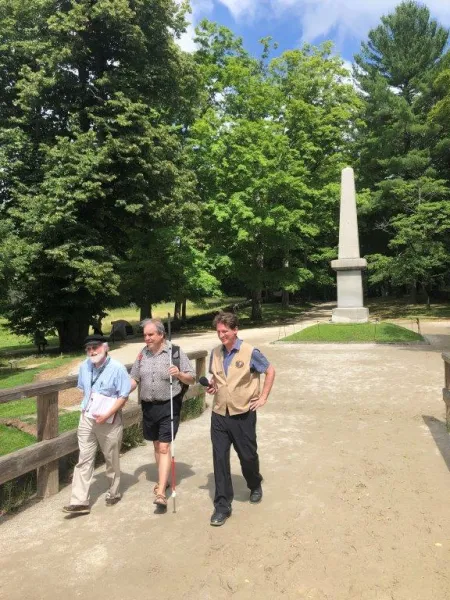
audio recorder to capture the thoughts of Bob Hachey, center, as they walk
across the North Bridge with NPS staff member Steve Neth
at Minute Man National Historical Park near Concord, MA.
The project will be led by Principal Investigator Dr. Brett Oppegaard, a visiting instructor in the Communication Department at Oregon Tech and an internationally recognized scholar in media accessibility, audio description, and mobile storytelling. Working with the Chinook Indian Nation, the City of Astoria, Lewis & Clark National Historical Park, the Lower Columbia Preservation Society, the American Council of the Blind, the Society of the War of 1812, and others, including fellow Communication faculty member Dr. Amber Lancaster, the team will research, co-create, and test audio narratives that interpret the fort's complex and contested history.
The finished stories will be delivered through the research team's open-access UniDescription platform, an award-winning geolocation-based mobile system already in use at more than 200 National Park Service sites nationwide. Visitors to Fort Astoria will be able to trigger location-specific audio narratives as they move through the site, while remote audiences will be able to access the same stories online, regardless of visual acuity or physical distance from Astoria.
“Fort Astoria has been overlooked for far too long, given how foundational it is to early American history on the West Coast,” said Oppegaard, who teaches UX Research and Design classes at Oregon Tech. “This project lets us tell that story, in all of its complexities, including Chinook, American, and British perspectives, in ways that are fully accessible to everyone, not as an afterthought, but as the core of the experience.”
The multi-year project includes historical research and tribal consultation, audio description script development with consultants who are blind or low-vision, prototype testing, on-site evaluation, and a public rollout, with Oregon Tech and the UniDescription team providing long-term stewardship of the platform after launch. Oppegaard said the model is designed to be scalable to other ABPP-funded battlefield sites across the nation, including those with limited access and sparse physical remains.
Oppegaard’s research background in accessibility and user experience (UX) includes collaborations with hundreds of public places, including iconic national landmarks such as Yellowstone National Park, the White House, the Grand Canyon, the Statue of Liberty, and the Lincoln Memorial. Besides grants from the National Park Service, his research has also been funded by the National Endowment for the Humanities, the National Endowment for the Arts, and various corporations, such as Google.