
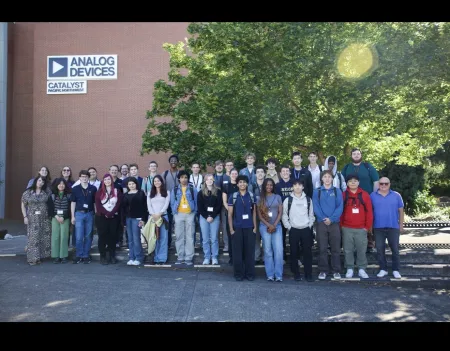
Two Oregon Tech Mechanical Engineering students were selected to participate in a two-week Semiconductor Training Camp hosted at Analog Devices in Beaverton, with support and mentorship from Analog Devices and Intel engineers through an opportunity coordinated by Oregon State University.
Students Grayson Moore and Kanon Kintner participated in the program, which brought together 30 students from Oregon universities for hands-on learning in robotics, semiconductor manufacturing, artificial intelligence, and industry career pathways.
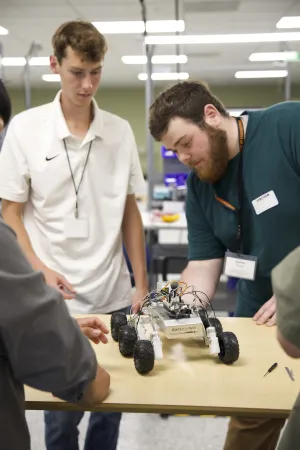
During the first week of the camp, students worked in teams to build and configure model rovers. The project included soldering, assembly, coding, and a final obstacle course challenge. Students also presented ideas for how their rover designs could be improved to address real-world problems.
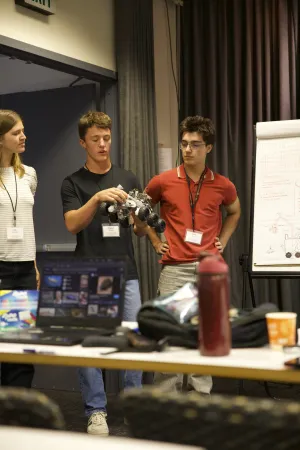
“I was able to solder wires, assemble the rover, and help configure the C++ code needed to run the rover,” said Grayson, who is also minoring in Information Technology. “Working with the rover taught me a lot. Being in a team the whole time taught me about effective group communication. When there were problems, we had to talk through it effectively to solve it.”
Kanon said the team-based robotics project helped him better understand coding and design decisions, and required students to communicate as a team.
“When building this robot, only one member was allowed to see the instructions, and that member was not allowed to touch the robot. They had to relay specific information to the rest of the group as we worked to build it,” Kanon said. “This process also taught me about 3D printing and how valuable it can be. At the end of the obstacle course, our robot needed to push a button that was 9 cm off the ground. Each group 3D printed a part, but every group did it differently, attaching it to different spots and all looking different.”
The second week focused on semiconductor manufacturing and included virtual reality training, industry presentations, and visits to Intel. Students learned about the stages of chip production, cleanrooms, chip testing, design processes, and the roles of automation and artificial intelligence in advanced manufacturing.
Grayson said the experience helped him understand the scale of the semiconductor industry and the range of career opportunities connected to engineering and technology.
“It really opened my eyes to how vast the industry is, as well as how many opportunities there are,” Grayson said. “I realized that these fields, engineering, technology, computers, and AI, make a difference and shape the world we live in. These industries make innovation possible.”
Kanon said he entered the camp with little knowledge of semiconductors, but everything was explained in a way that he could participate and apply it to his mechanical engineering experience. For Kanon, the team aspects were also an important part of enjoying the camp.
“Throughout the camp, the organizers explained everything in a way that prior knowledge helped, but wasn't necessary. I was able to participate and understand things the same as my peers,” Kanon said. “Additionally, peers are a huge part of what made this process so enjoyable. The exclusiveness of this camp created an extremely academic environment. Everyone in the camp wanted to be there and participated accordingly. This also meant that great questions were asked during each presentation that deepened my understanding in ways I wouldn't have thought of.”
The program also connected with Oregon Tech’s emphasis on interdisciplinary learning. Grayson is considering Oregon Tech’s new Artificial Intelligence major as a possible double major with Mechanical Engineering, and Kanon left with a greater awareness of how to use new AI tools to help him research and better understand topics.
Praveen Guraja, Ph.D., Assistant Professor of Cybersecurity and Information Technology, said the experience reflects the expanding connections between engineering, information technology, artificial intelligence, robotics, and semiconductor manufacturing.
“I think this is an excellent example of the future direction we may see across campus, where students combine AI with another discipline to become more competitive in the job market and better prepared for opportunities that involve AI, automation, robotics, and advanced manufacturing,” Guraja said. “We are very proud of Grayson and Kanon and grateful that they had this opportunity.”
###