
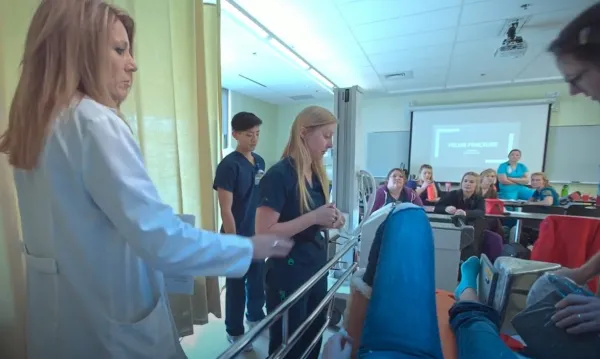
The Bachelor of Science in Allied Health prepares students for dynamic careers in healthcare by combining a strong foundation in science with practical skills for patient care and health services.
Information
Designed for those passionate about improving lives, this program offers flexible pathways for students pursuing professional roles in healthcare. With a focus on evidence-based practice, critical thinking, and hands-on experience, this program equips graduates to meet the growing demand for skilled healthcare professionals and make a meaningful impact in diverse clinical and community settings.
What You'll Learn
Allied Health is a multidisciplinary program designed to provide students with a strong general foundation in healthcare from a range of fields, including basic science, medical sociology, psychology, business, management, and communication. The program can also serve as the first year of prerequisites for Respiratory Care, Medical Imaging, Dental Health, and Medical Laboratory Sciences, giving our students a chance to choose what they want to focus on for their careers. Regardless of your career path choice, you’ll still learn about these concepts: Health inequality, social determinants of health, medical ethics, genetics, healthcare quality, biopsychology, and more. You can also earn your degree here and use it to continue your education to earn healthcare credentials, such as phlebotomy or medical assistant, to gain access to clinical employee healthcare jobs, or to apply to professional graduate school with your Allied Health degree.
Program Learning Outcomes:
- Apply critical thinking skills to analyze concepts, research, and theories, and effectively translate them into professional practice.
- Analyze, interpret, and respond to the key factors that influence healthcare delivery and policy.
- Apply basic administration and management skills.
- Function as educators, team players and/or leaders in academic, clinical, or community healthcare settings.
Contact Admissions
The departmental faculty advises students. View the list of academic advisors.
If a student is unsure who their assigned academic advisor is, please contact the department chairperson or the Academic Advising office below.
Allied Health Courses
The Allied Health program is a springboard into new career pathways in administration and clinical work. Leverage what you know and push yourself to grow.
- Students will take foundational courses such as Human Anatomy/Physiology, General Chemistry, Medical Sociology, and Healthcare Management to prepare students for the field of healthcare
- Courses in Team Communication, Intercultural Communication, and Ethics contribute to our graduates being well-versed in technical and communication skills
- Program courses and the senior project teach students how to manage projects, analyze, and solve real-world problems in operational areas, including business, science, and leadership, using both quantitative and qualitative methods
Small Class Sizes
Small class sizes ensure students understand the concepts being taught and how to apply theory to action.
Internships
In your junior year, you will have the opportunity to apply your education through an internship, working closely with your faculty and industry partners.
Laboratories
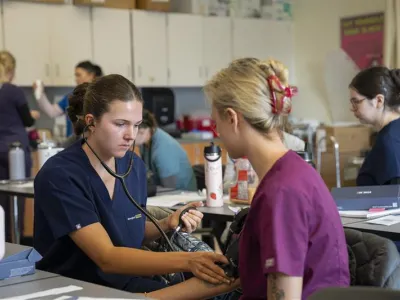
We have labs devoted primarily to undergraduate education and science classes, giving you the chance to get hands-on early in your education.
Careers
Allied Health graduates may either seek employment or obtain an advanced degree within six months of graduation. Our alumni in graduate school often report that they are better prepared than their peers from other universities, and they frequently become leaders within their graduate programs, ultimately achieving high success in their professional careers.
Healthcare Administrator
Clinic Manager
Nursing Home Administrator
Medical Records Manager
Healthcare Compliance Manager
Healthcare Consultant
Grad School:
- Master of Healthcare Leadership
- Master of Public Health
- Master of Business Administration
Financial Aid & Scholarships
Scholarships are available for students from all walks of life—first-time college students, career changers, and everyone in between. Take the first step toward an affordable, high-quality education and let us help you build the skills you need for a brighter tomorrow.
Professor
DOW207
DOW220
I have been a member of the Natural Sciences faculty at Oregon Tech since Fall 2000. I mainly teach biochemistry and clinical pharmacology in our Biology-Health Sciences (BHS) program, although sometimes I have taught other courses too, including medical genetics, organic chemistry, immunology labs and general chemistry labs. I am proud of all the places of our alumni have gone on to, which are often into post-graduate medical programs like medical doctor, pharmacist, dentistry, physician assistant, veterinary medicine, physical therapy and others. All of these are focused differently from my own educational background, so I make it a priority to help my students think about biochemistry in ways that are applicable to medicine, rather than memorizing a bunch of facts that they could look up and will forget anyway. If you ever meet one of my former biochemistry students, ask them “how much wood could a woodchuck chuck?”—chances are they will remember it from my class, and maybe even how the woodchuck analogy can help explain enzyme kinetics.
I also advise students in our BHS program, and I am always eager to meet with prospective students, or to answer their questions by phone or email.
Outside of classes, I have been a mentor for a variety of undergraduate research projects. Currently I am working with students to study the molecular genetics of cyanobacteria (blue-green algae) in nearby Upper Klamath Lake, along with our department’s microbiologist, Professor Kamal Gandhi. My previous student-involved projects have included cloning of particular bacterial genes/proteins that had never been closely studied before, creation of a home-built fluorescence microscope with 3D-printed parts, finding errors in published, experimentally determined 3D molecular structures of proteins, and developing a simple method to test for gene variants in a dopamine receptor that has been linked to ADHD and risk-taking behavior.
In our cyanobacteria project, students isolate and quantify DNA from bacteria sampled from Upper Klamath Lake, and develop PCR (polymerase chain reaction) methods to identify which species are present and in what proportions. We also send out some samples for full-genome sequencing and analyze the massive amounts of data that come back from that. Along with being involved in genuine scientific discovery, students learn to work independently and as a team in the lab, develop and troubleshoot experimental protocols, and present their results to the university and at regional conferences.
The cyanobacteria that we study are ecologically interesting and important because they affect water quality in the lake—some of them produce toxins while others are harvested as healthy nutritional supplements. The balance between those opposites changes seasonally over each summer and likely between different locations in the lake. Upper Klamath Lake is also home to two species of critically endangered suckerfish (c’waam and koptu) that are culturally important to the Klamath Tribes. Every summer, the hatchlings of these fish have been dying off, so that while there are still some long-lived older fish, they are not able to be replaced in the lake. There is no one factor that controls the non-survival of the juvenile suckerfish, but the role of cyanobacteria, the toxins they produce, and the effect they have on oxygen depletion in the water are all worthy of further study in hopes of helping the fish.
Before I came to Oregon Tech, I earned a BSc (Honours) in Biochemistry from the University of Alberta (I’m Canadian, eh!), a Ph.D. in Chemistry from University of Oregon in Eugene, and did post-doctoral research at University of Texas Southwestern Medical Center in Dallas. I also was a partner in a computer software consulting business for a few years.
When I’m not working, some of my hobbies include running, backpacking and camping. Last year my daughter and I took an amazing 9-day wilderness backpacking trek north of the Arctic circle on Baffin Island in Canada. I’ve climbed on Mt Shasta a bunch of times, including a couple where I guided former students to the summit. I often bicycle-commute to campus including in the snow, and I use my mountain bike, road bike and tandem bike for fun. In the summer of 2021, my spouse and I logged 1000 miles on our tandem in five months, doing various day rides all over Oregon.
Natural Science Links
Additional Resources
Related Programs