

Program Accreditation
The Bachelor of Science (B.S.) degree in Electrical Engineering is accredited by the Engineering Accreditation Commission of ABET, http://www.abet.org.
Program Mission
The mission of the Electrical Engineering Bachelor of Science degree program is to provide a comprehensive program of instruction that will enable graduates to obtain the knowledge and skills necessary for immediate employment and continued advancement in the field of electrical engineering.
Program Educational Objectives
- The graduates of the BSEE program will possess a strong technical background as well as analytical, critical-thinking, and problem-solving skills that enable them to excel as professionals contributing to a variety of engineering roles within the various fields of electrical engineering and the high-tech industry.
- The graduates of the BSEE program are expected to be employed in electrical engineering positions including (but not limited to) design engineers, test engineers, characterization engineers, applications engineers, field engineers, hardware engineers, process engineers, control engineers, and power engineers.
- The graduates of the BSEE program will be committed to professional development and lifelong learning by engaging in professional or graduate education in order to stay current in their field and achieve continued professional growth.
- The graduates of the BSEE program will be working as effective team members possessing excellent oral and written communication skills, and assuming technical and managerial leadership roles throughout their career.
Student Outcomes
- An ability to identify, formulate, and solve complex engineering problems by applying principles of engineering, science, and mathematics.
- An ability to apply engineering design to produce solutions that meet specified needs with consideration of public health, safety, and welfare, as well as global, cultural, social, environmental, and economic factors.
- An ability to communicate effectively with a range of audiences.
- An ability to recognize ethical and professional responsibilities in engineering situations and make informed judgments, which must consider the impact of engineering solutions in global, economic, environmental, and societal contexts.
- An ability to function effectively on a team whose members together provide leadership, create a collaborative and inclusive environment, establish goals, plan tasks, and meet objectives.
- An ability to develop and conduct appropriate experimentation, analyze and interpret data, and use engineering judgment to draw conclusions.
- An ability to acquire and apply new knowledge as needed, using appropriate learning strategies.
Summary of Program Student Learning Outcomes
The Electrical Engineering and Renewable Energy faculty formally assess the student learning outcomes summarized in the annual program assessment report. Additional details can be found in department assessment records.
Program Curriculum Map
The curriculum map for the Electrical Engineering program can be found on the catalog web page on the Oregon Tech website, www.oit.edu/catalog.
Annual Program Assessment Reports
Contact
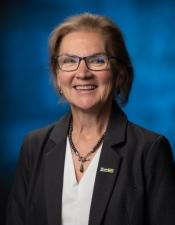
Dr. Neslihan Alp is Dean of the College of Engineering, Technology, and Management at Oregon Institute of Technology (Oregon Tech), a position she has held since January 2024. Previously, she served as Vice President for Academic Affairs and Provost at Pennsylvania College of Technology, Dean of the Bailey College of Engineering and Technology at Indiana State University, and Associate Dean and Professor at the University of Tennessee at Chattanooga.
Dr. Alp earned her B.S. in Engineering Management and M.S. in Industrial Engineering from Istanbul Technical University and her Ph.D. in Engineering Management from the University of Missouri-Rolla. She has authored more than 100 publications and has secured over $50 million in grants and philanthropic support throughout her career. Her academic leadership includes developing and expanding programs in emerging and high-demand fields, advancing online education, and strengthening industry and workforce partnerships.
A licensed Professional Engineer and Fellow of the American Society for Engineering Management, Dr. Alp has received numerous awards for teaching, research, service, leadership, and contributions to diversity in STEM. She serves as an ABET Commissioner and was elected to the Board of the National Institute for Engineering Ethics (NIEE) for a three-year term beginning July 1, 2026.